
About Us

Internal Quality Assurance Cell


Internal Quality Assurance Cell (IQAC) – 2025-2026

CompositionNature of SelectionName of members
ChairpersonPrincipalDr. Veena V.
Teachers to represent all level (Three to eight, the senior among them will be the coordinator/director)

IQAC Coordinator and joint coordinators nominated by the management
ISO MR
KTU coordinator
IAC Convenor
NAAC Coordinator
DQAC Coordinators

Members of DQAC are nominated by the HOD.

Among two members one is IQAC representative who serves as DQAC coordinator and the other member is the member of Internal Audit Cell (IAC)

Prof. Paul Ansel V, VP, Admn. (AISHE Nodal Officer)
Prof. Kanaka Xavier, VP, Academics & NAAC Coordinator
Prof. Anu Antony, Coordinator
Prof. Thomas Felix, Joint Coordinator, ISO MR
Prof. Vilbin Varghese, Joint Coordinator
Prof. Divya Mohan, Joint Coordinator

Prof. Aswathy Chacko, NAAC Joint Coordinator
Prof. Asha K. R., KTU coordinator
Prof. Sheeja M. K, IAC Convenor
Prof. Liji Anna Mathew,DQAC Coordinator (CE)
Prof. Lima Sebastian, DQAC Coordinator (AI&ML)
Prof. Nisy John Panicker, DQAC Coordinator (CSE)
Prof. Sonu K Varghese, DQAC Coordinator (ECE)
Prof. Avinesh Pyarilal, DQAC Coordinator (ME)
Prof. Deepu John, DQAC Coordinator (EEE)
Prof. Rose Paul, DQAC coordinator (ASH)

One member from the ManagementAssistant ManagerRev. Fr. Manoj Francis Marottickal
Administrative Officer Mr. Leonard John C.
Nominee from local societyNominated by the managementAdv. Sherry J Thomas
Nominee from Alumni Mr. Jess Boban
Nominee from Professional body Dr. Anil Joseph, Secretary , IGS – Kochi Chapter & Managing Director Geo Structurals Pvt. Ltd., Kochi
Nominee from Industry Mr. Jacob Rajan, Director ,Scaleios Pvt. Ltd., Kochi
Nominee from ParentsPTA Vice-PresidentMr. Thomas Dominic
Nominee from StudentsCollege Union ChairpersonTo be nominated


IQAC Executive Committee

CompositionName of members
IQAC CoordinatorProf. Anu Antony
IQAC Joint coordinators

Prof. Thomas Felix
Prof. Vilbin Varghese
Prof. Divya Mohan

NIRF CoordinatorProf. Vilbin Varghese
ISO MRProf. Thomas Felix
Internal Audit Cell ConvenorProf. Sheeja M. K

NAAC Coordinator

NAAC Joint Coordinator

Prof. Kanaka Xavier

Prof. Aswathy Chacko

APJAKTU coordinatorProf. Asha K. R.
DQAC CoordinatorsProf. Liji Anna Mathew (CE)
Prof. Lima Sebastian (AI&ML)
Prof. Nisy John Panicker (CS
Prof. Sonu K. Varghese (ECE)
Prof. Avinesh Pyarilal (ME)
Prof. Deepu John (EEE)
Prof. Rose Paul (ASH)

Internal Audit Cell 

Composition

Name of members

Chairperson

Prof. Anu Antony (ECE)

Convener

Prof. Sheeja M K (CE)

Secretary

Prof. Sweety Joy (CSE)

Members

Dr. Rinku John (CE)

Prof. Dhanya George (ASH)

Prof. Tubin T X (ECE)

Prof. Lekshmi Babu (EEE)

Prof. Binju Varghese (ME)

Prof. Kalyani (AI&ML)

KTU Audit Reports

KTU Audit Reports refer to the periodic academic and administrative audits conducted in accordance with the standards and requirements of APJ Abdul Kalam Technological University (KTU). At Albertian Institute of Science and Technology, these reports provide an objective assessment of academic processes, curriculum implementation, teaching–learning activities, student performance, faculty contributions, documentation, and institutional facilities. The audit findings help identify strengths, gaps, and areas requiring corrective action, thereby supporting continuous improvement and ensuring compliance with KTU norms. Overall, KTU audits strengthen academic quality, accountability, transparency, and the institute’s commitment to maintaining high educational standards.

Institutional Development Plan

The AISAT Institutional Development Plan (IDP) acts as a strategic roadmap that guides the institution’s growth while promoting academic excellence, fostering research and innovation, and strengthening its contributions to society.

Institution Development Plan

Quality Initiatives and Policies

Albertian Institute of Science and Technology (AISAT) promotes quality through systematic academic monitoring, continuous improvement, faculty development, student support, outcome-based education, and stakeholder feedback. Its quality initiatives focus on enhancing teaching–learning processes, encouraging research and innovation, strengthening industry interaction, and improving infrastructure and institutional services. The institute’s policies emphasize transparency, accountability, student satisfaction, professional ethics, continuous assessment, and compliance with prescribed academic and quality standards. Together, these initiatives and policies create a culture of excellence and support the institute’s commitment to continuous institutional improvement.

Quality Manual and Procedures

(For internal circulation only)

The Quality Manual of Albertian Institute of Science and Technology (AISAT) provides a structured framework for maintaining and continuously improving the quality of education, administration, infrastructure, and support services. It outlines the institute’s quality objectives, policies, responsibilities, procedures, and mechanisms for monitoring academic and institutional performance. The manual emphasizes student-centred learning, effective teaching practices, faculty development, stakeholder satisfaction, documentation, internal evaluation, and continual improvement. Overall, it serves as a guiding document to ensure that AISAT consistently meets academic and professional standards while fostering a culture of quality, accountability, and excellence.

About NBA Accreditation

The National Board of Accreditation (NBA), India was initially established by the AICTE (All India Council of Technical Education) in order to assess the qualitative competence of the programs offered by educational institution.  NBA came into existence as an independent autonomous body with effect from 7th January 2010 with the objectives of assurance of quality and relevance to technical education, especially of the programs in professional and technical disciplines, through the mechanism of accreditation of programs offered by technical institutions. The NBA conducts evaluation of programs of technical institutes on the basis of laid down norms. This may include, but not limited to institutional missions and objectives, organization and governance, infrastructure facilities, quality of teaching and learning, curriculum design and review and support services (library, laboratory, instrumentation, computer facilities, etc.)

Accredited Programs at AISAT

About NIRF


National Institutional Ranking Framework (NIRF) is a ranking methodology adopted by the Ministry of Education, Government of India, to rank institutions of higher education in India. The framework was approved by the former Ministry of Human Resource Development (now the Ministry of Education) and launched by the Minister on 29 September 2015.
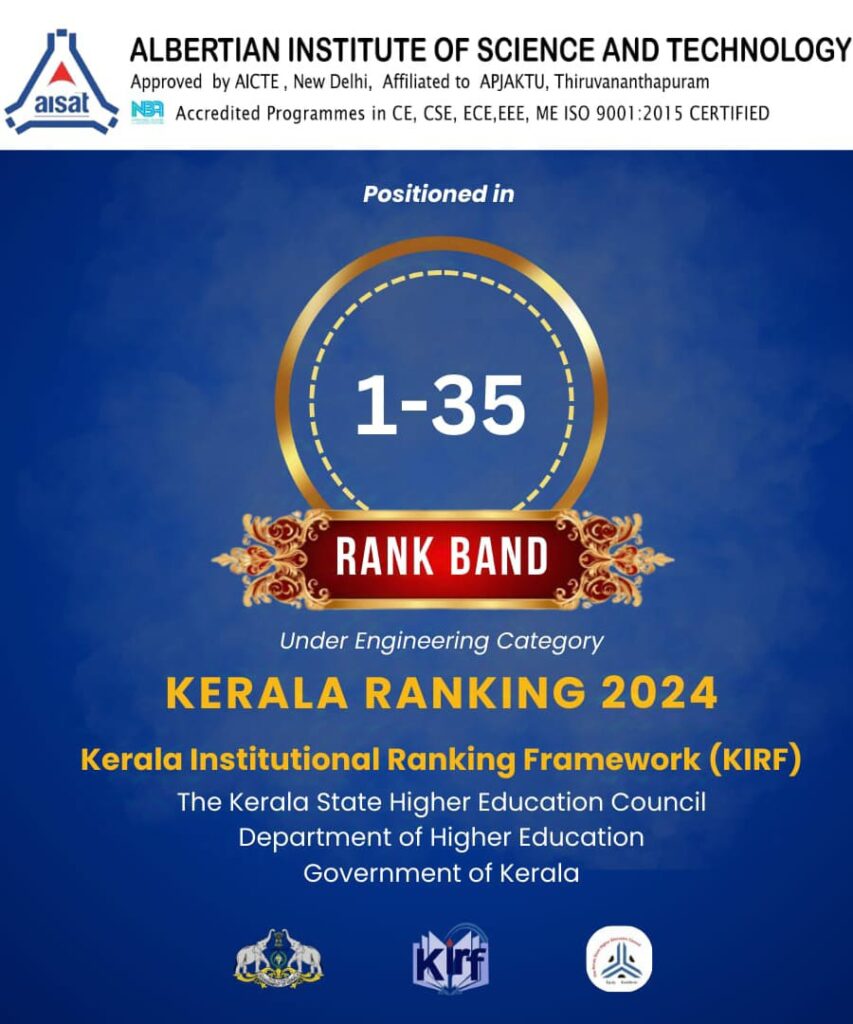
Submitted Institute Data for NIRF

The Kerala Institutional Ranking Framework (KIRF) ranking provides an objective assessment of higher-education institutions in Kerala based on parameters such as teaching and learning, research, infrastructure, student support, placements, and institutional practices. For Albertian Institute of Science and Technology, participation in KIRF reflects its commitment to benchmarking institutional performance and identifying areas for improvement. The ranking process encourages transparency, healthy competition, continuous quality enhancement, and stronger academic and professional outcomes, thereby supporting the institute’s overall pursuit of excellence.
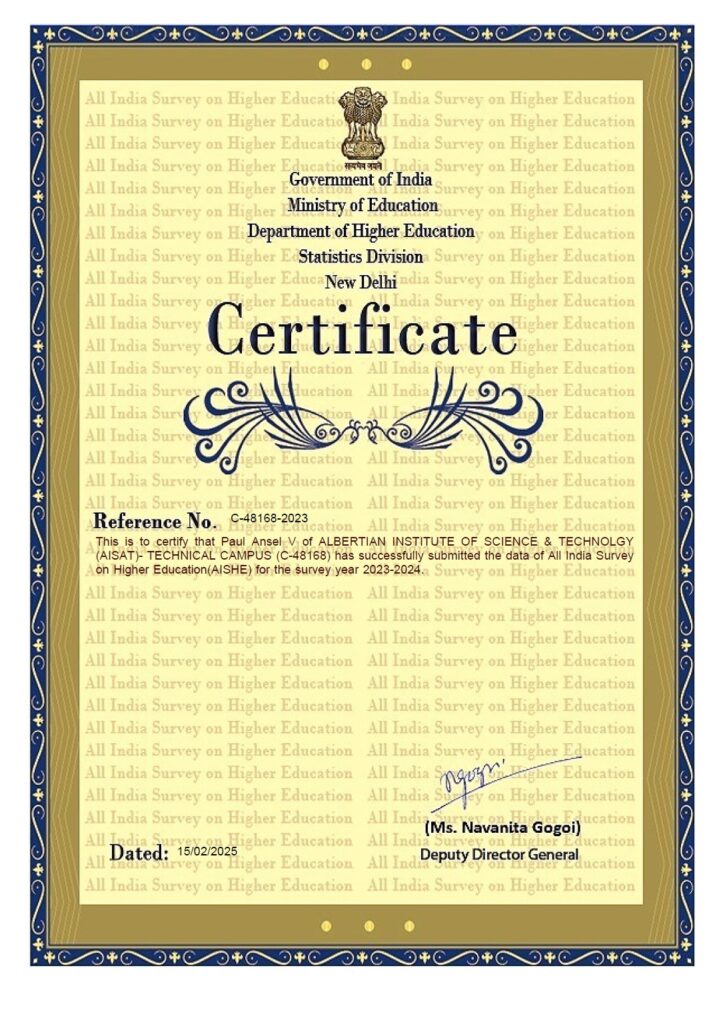
The AISHE (All India Survey on Higher Education) Certificate is an official record confirming an institution’s participation in the Government of India’s annual survey of higher education. For Albertian Institute of Science and Technology, the certificate serves as evidence that institutional information relating to students, faculty, programmes, infrastructure, and other academic details has been submitted through the AISHE system. It supports institutional transparency, reliable educational data reporting, and compliance with national higher-education information requirements.
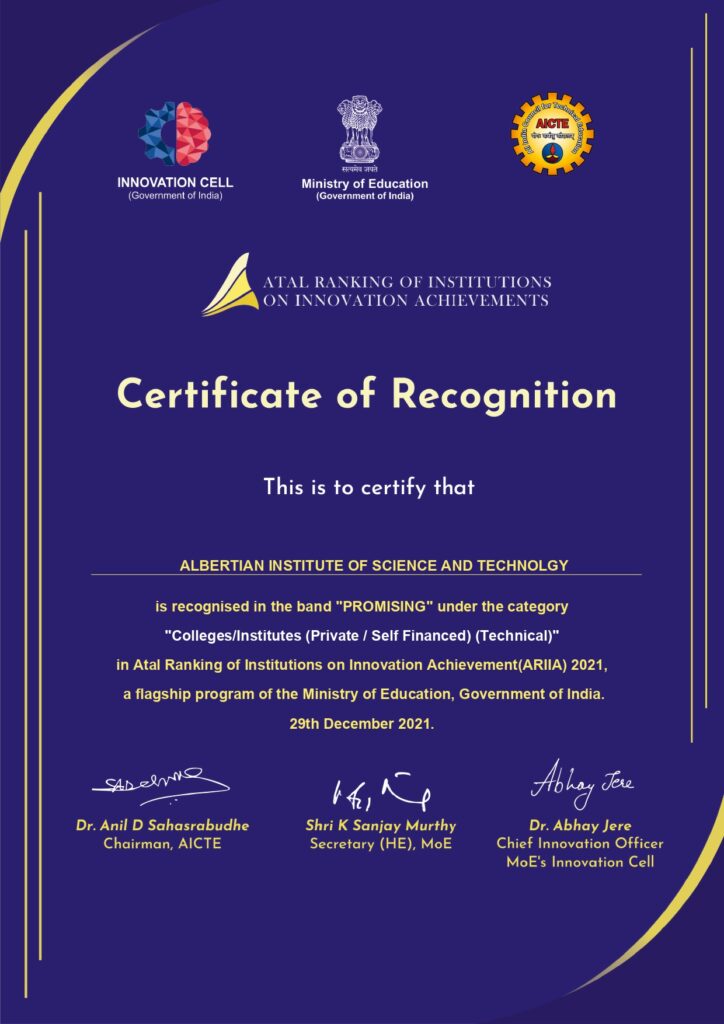
The ARIIA (Atal Ranking of Institutions on Innovation Achievements) ranking evaluates higher-education institutions based on their achievements in innovation, entrepreneurship, research, technology development, intellectual property, and industry collaboration. For Albertian Institute of Science and Technology, participation in ARIIA reflects its efforts to promote innovation and entrepreneurship among students and faculty. The ranking encourages the development of an innovation-driven academic environment, strengthens industry and research linkages, and helps the institution identify opportunities for continuous improvement in innovation and entrepreneurial activities.